

The runner's high and spiritual awakening

I recently read a scholarly paper that referenced Arne Dietrich’s 2003 “Functional Neuroanatomy of Altered States of Consciousness: The Transient Hypofrontality Hypothesis,” and I realized what a terrible blog post it would make.  There are literally four or five words in the title alone that I would need to look up in a dictionary before getting any further!  But there IS something that stood out to me among the (very few) notions I could actually understand from the article:

 “[A] capacity for running also apparently contributed to the emergence of spiritual experiences, a by-product of the capacity of long-distance running to alter consciousness.  This is recognized in the “runner's high," which has features typical of mystical experiences, including: positive emotions such as happiness, joy and elation; a sense of inner peacefulness and harmony; a sense of timelessness and cosmic unity; and a connection of oneself with nature and the Universe.”

 In layperson’s terms, Dietrich is basically stating that if we run long enough, and push our bodies to (and through) our known limits, we can actually alter our current experience and how our brains perceive the world around us.

 Of course, for me, this concept incited numerous questions and possibilities in itself:

Could running be a vehicle for entry into the mystical realms?  Are runners the shamans and witch doctors of a new age?  Am I taking crazy pills or having some kind of flashback? (Probably, but I digress…)

These are the questions that have kept me awake at night. And it’s these types of questions for which I hope to provide some insight, for others seeking to find deeper meaning in their running, as I continue to do.  

 Don’t get me wrong. I’m not trying put myself out there as some kind of awakened mystic – if you asked my wife and kids, they’d confirm for you that I’m just as ignorant and unenlightened as the next dude who just happens to own a pair of running shoes.  With that said, I have been fortunate enough over the years to have been able to  study actual enlightened individuals and their teachings; I’ve also been fortunate enough to be able to run  multiple marathons and ultras… So I’m going to continue in that fortuitous vein and ramble on about this notion of enlightenment and the runners high for those who choose to read.  So bear with me…

 I consider myself very lucky to have had more than one experience that has altered the way I view the world in a way that makes me a more compassionate and understanding — and less intolerant — person.  One of those experiences in particular stands out to me as a seismic shift in my worldview. The experience is one that changed the course of my trajectory and brought me to where I am today.  Recently looking back on that experience, I realized that my state of mind was almost identical to its state at the end of an extra long run, when I am physically spent and spiritually open to the universe.  It’s a unique state of mind where I feel a dropping away of all the layers of crap that have built up around my soul, where I can see things as they really are, without the filters of my experience and preconceived ideas.One of the first times I had this feeling was in my 20s:

 It was back in the mid-90s. I was a young, but very clean-cut hippie working for the Utah Rivers Council, a small conservation group working to protect — you guessed it — the rivers of Utah.  We had tasked ourselves with stopping unnecessary dam construction to keep the pristine waterways of the Beehive State wild and free, and we had been very successful in an extremely construction-friendly environment.  Not only had we been instrumental in passing the “Utah Clean Water Act of 1998”, but we had also just won a huge victory for taxpayers and nature lovers, by stopping the proposed construction of a dam in along the Diamond Fork Creek – a beautiful canyon that was home to a scenic and popular hot springs.

 Our work to stop the project, which would have cost Salt Lake City taxpayers millions to divert water to central Utah ranchers to water alfalfa for their cattle, was long and hard, but we were elated by our success.  The proposed dam was scrapped, and less expensive and environmentally destructive alternatives were being looked at to keep the ranchers and their cattle happy and well-fed.  As part of the public education process about alternatives to the dam, I was invited to attend a tour of Diamond Fork Canyon with the water district and the ranchers we had opposed for so long.  This is where it gets fun (for me,not you. I already know what happens but you still have to read this…).

 It was a late summer day when the tour was to take place.  I drove alone from Salt Lake City to Spanish Fork, about an hour away, to meet up with my rancher “friends” and start the tour.  Over the course of the hour, I thought about what it would be like to spend my day with a bunch of Utah ranchers who probably disliked me as much as I did them, for the type of work I did.  I thought about how alone I’d feel with these folks in their cowboy hats and boots, how out of place I would be following their massive pickups up the canyon in my Subaru wagon.  I spent most of the hour-long drive separating myself in my mind from these guys, thinking about the ways I was different from them.  I built up such an image of the division in my mind, that by the time I reached the meeting point, I had decided to skip the meeting entirely, and I drove right past.

 I resolutely decided that instead of spending my day with a bunch of “jerks” who hated me, with whom I had absolutely nothing in common, I would drive right up the canyon, hike to the hot springs, and enjoy myself.  I’d brought along a lunch and some light reading (Zen and the Art of Motorcycle Maintenance, of course), and felt like I’d earned a nice warm soak in the hot springs. I parked my car, grabbed my rucksack, and started up the trail to the springs.

 It was a beautiful day; it was about 10 AM when I started the 20 minute hike to the hot springs.  I remember passing a small group of people on my way in, but when I got to the springs, nobody else was around.  The hot springs themselves were beautiful – several roughly formed pools ringed by rocks that kept the naturally heated water in place and at different temperatures.  The creek flowed by gently next to the pools. Upstream about 20 yards, it tumbled over a small falls about eight feet high that you could actually sit behind and watch the wide ribbon of water fall through the air.  I took out my book, waded into one of the hot pools, and immediately relaxed. 

 I still remember the next two hours as one of the most peaceful times I’ve ever experienced.  The sky was blue, the trees were still green despite the changing seasons, the air was just crisp enough to make everything stand out, and I simply melted into the water.  I felt no guilt over skipping out on the tour (but to be fair, my work ethic has always been a little questionable). I enjoyed myself sitting in the various pools, listening to the creek, cooling off in the waterfall, and just letting a meditative bliss wash over me.  I spent a little time reading, a little time eating my lunch, a little time sleeping, and after awhile decided it was time to head back down the canyon and return to Salt Lake.

 And of course…this is where things became interesting for me.  As I neared the mouth of the canyon, I looked over at the opposite bank of the creek and saw a mid-sized group of guys with a group of mid-sized pickup trucks — it was the tour I’d skipped and the ranchers I’d so despised and demonized in my mind.  At first, I didn’t notice anything special about the group. I remember seeing them sitting on the beds of their trucks, on the bank of the creek, talking to each other and eating their lunch.  I wanted to categorize the image I saw under “enemy” in my mind, but something wouldn’t allow me to do that. 

 Something about my state of mind in that moment would not let me hate.  I couldn’t dredge up a feeling of dislike for the people I was looking at.  All at once, any enmity I felt toward this group of individuals, toward anyone for that matter, dissolved.  It was replaced by something warm, a feeling of understanding, of connection.  I imagined these men waking up in the morning, kissing their wives and children, grabbing those lunches they were now chowing down on, and heading out the door to go on this tour.  I could see inside them as a group of humans– inside to the very center of their beings.  And what I saw shocked me – it was no different from what I experienced in my own heart and soul.  I suddenly realized that nothing separated me from the cattle ranchers; nothing made their experience of life, their worldview, any less valid than mine.  I realized that my motivation and theirs were identical. We were all striving for happiness and fulfillment in the ways we’d learned through nature and nurture, and that to any of us, beyond even the group of ranchers and extending to everyone else on Earth, that desire for happiness and fulfillment was our greatest motivator.  What I experienced was a sudden awakening, satori in Zen terms. It was a sense of unity and interconnection with all beings and an understanding that altered my own worldview. 

 William James, author of The Varieties of Religious Experience, set forth four defining qualities of mystical experiences:

 1.      Ineffability. According to James the mystical experience "defies expression, that no adequate report of its content can be given in words".

2.      Noetic quality. Mystics stress that their experiences give them "insight into depths of truth unplumbed by the discursive intellect." James referred to this as the "noetic" (or intellectual) "quality" of the mystical.

3.      Transiency. James notes that most mystical experiences have a short occurrence, but their effect persists.

4.      Passivity. According to James, mystics come to their peak experience not as active seekers, but as passive recipients.

 I’m not sure that I considered my glimpse of what I now believe to be an ultimate truth that day to be a mystical experience, but I know that it fits the bill according to James.  Even though I’ve written about it here, I know that the words I have used do not come close to encapsulating the effect that the moment had on me.  Striking me from out of the blue, my experience was certainly passive, and while I can’t quite touch the experience now, it changed me permanently.  I consider it a gift from the hot springs.

 My brief glimpse was more than 20 years ago, and I have had few similar mystical moments in the time since then; the closest I have come to the same ineffable feeling has been during and after extremely long runs.  The focus on breathing, the repetitive nature of placing one foot in front of the other for hours on end, the wearing down of body and mind, and the fact that all of this is often done in the great outdoors, bring me into a similar state of vulnerability and openness to my experience, without the usual filters. 

 I most recently entered this state around mile 38 of the JFK 50 Miler, somewhere along the Potomac River.  I’d been running for more than 7 hours and was nearly asleep on my feet.  Literally.  I was having a hard time keeping my right eye open in particular, but I told myself to push through to the next aid station, which wasn’t very far ahead. I kept up hope for a second (or third, or maybe tenth by that point) wind.  I reached that aid station, chugged a couple of flat sodas, and continued on, somehow still running at a decent pace.  Surprising myself more than anyone (my first words across the finish line were “Holy Shit!”), I run-walked the final 12 miles and finished the damn thing! 

 The euphoria and openness to experience that followed reminded me a lot of that hot springs experience.  Everywhere I turned I saw beauty, connection, love.  I stayed at the finish line and cheered on my fellow runners as they came into view.  I felt a deep kinship with them, the spectators, the volunteers, the cops blocking off the road.  I looked up at the sky and in my mind’s eye, if not in reality, I saw beams of light streaming from the heavens.  Everything around me was perfect, just as it was. 

 It took me back to that place of realizing that, at our core, we are all just doing the best we can to get by in life. To meet our goals for our current season in our lives, whatever that may be. For me, in that moment, getting by meant running 50 miles. For someone else, the goal might be a half marathon, or a 5k. For the cops blocking off the road for the race, the goal was to keep runners safe and traffic moving. Then, of course, there are those individuals where their only goal is simply to get up in the morning and make it through the day. We are still all connected. That revelation of connectedness was my runners high.

 Running pushes us. It exhausts our resources and helps us realize that the strength for one more step comes not only from within, but also from pulling from every person and resource we’ve ever encountered in life. And when the steps keep coming, regardless of our preconceived notions of limits and the world around us, perhaps THAT is what we call our runners high. It’s realizing that we are greater than we realize, but there is always something going on that is greater than us… and that something demands brokenness and vulnerability, as well as openness and understanding and compassion, for ourselves and the world around us. It’s the kind of brokenness and vulnerability that connects us in a powerful way to nature and the universe around us, in a way that is not often encountered in every day life.

The Path is the Goal

Sentient beings are numberless; I vow to save them
Desires are inexhaustible; I vow to put an end to them
The dharmas are boundless; I vow to master them
The Buddha Way is unsurpassable; I vow to attain it.
 

Zen Buddhists are supposed to chant daily the lines above, known as the Four Vows, or Great Bodhisattva Vows. If you don’t know the term, a bodhisattva is a helper who has promised to forego enlightenment until all other sentient beings reach it – this is the ideal of Mahayana Buddhism, the “greater vehicle” (that’s what Mahayana means) that includes the Zen and Tibetan forms of the religion.  

I confess that I don’t chant every day, but this vow is very important in my practice and my life. When I spent a month in retreat almost 20 years ago, I was mumbling these words at five o’clock every morning, trying my best to really mean it.  Did I just promise to surpass something that I acknowledged in the very same breath is “unsurpassable”? Seems a little crazy, no? 

Yes, it does seem a little crazy! But striving bodhisattvas really mean it when we make these promises. When someone makes the decision to follow every other sentient being (or even just the two-legged ones!) on the way to enlightenment, instead of racing to get there first, that someone should know what they’re getting into, even while recognizing the absurdity of the effort.  The path is supposed to be a challenging one, and we are meant to take it seriously. Like my favorite marathon cheer sign says: “If it was supposed to be easy, it would be called your Mom.”  

But why try to do something that seems impossible at the outset? Why promise to set forth on a path that will never end? Why start down a road on which we seem destined to fail? Who in their right mind would make such promises? 

I would, that’s who! And lots of other Zen practitioners over the last thousand or so years. But this type of promise, to oneself in particular, can be entered into by anyone who wants to achieve what now seems unachievable. That’s because what really underlies the Bodhisattva Vow is the intention to attain the unattainable, not the belief that it’s actually possible (even though I’m convinced it is!). Zen practitioners, by making these promises, create a mindset that kicks off the journey toward helping others in the most radical way – sacrificing one’s own enlightenment in order to help others get there. This mindset is known as bodhicitta, loosely defined as “awakened heart-mind”.  

Awakening to your own innate bodhicitta to become a selfless helper is something I encourage and provide tools for in my coaching and workshops, but here I want to write about the more individual aspect of setting intention for runners – of stepping foot on the path toward the impossible. Maybe you’ve set your sights on a goal that from a distant perspective seemed unlikely or even ridiculous, or maybe you’re thinking about setting such a goal right now. Whether it’s just lacing up and getting out the door one or more days a week, running your first mile, or 5k, or marathon, or striving for a new personal record, creating the proper mindset – setting your intention – is the first step. 

You can’t develop a mindset without mindfulness. I’ve written before about how slowing down the natural chatter of our minds and being more present can help quiet the kind of self-doubt, the negative talk that pervades a lot of people’s thinking. The little voice that tells you that your goal is unreachable, impossible. With mindfulness practice, you can shut that voice up, even if it’s just long enough to see clearly how it was holding you back. And each time you realize that, you move another step forward on your journey. See how that works? 

The path is the goal, and it’s mindfulness that keeps you on the path. It reins you in from dwelling on past failures and fantasizing about what your future holds, and can help you focus on the task at hand. But even more so, with mindfulness (especially the kind that is developed through sitting meditation, although it can be integrated into running, as well) you begin to embody your intention – the promises you make are digested and become part and parcel of who you are. More accurately, you begin to reflect your genuine nature, which contains all the tools it needs to attain the unattainable.  

So, runners, I encourage you to enter into the Bodhisattva Vows and make the world a better place, but I’d also like to suggest a new, more earthly, vow for all of us – a Great Runnersattva Vow, so to speak. You can put it into your own words, but here’s mine: 

My goals are futile; I vow to achieve them
The soreness is unbearable; I vow to foam roll through it
My self-doubt is overwhelming; I vow not to be persuaded by it
The miles are infinite; I vow to run them all!

HAPPY RUNNING!

3:59:77

Today marks the tenth anniversary of my first marathon – the 2009 Philadelphia Marathon – and so I have been reflecting on my decade as a “marathoner” —  what I’ve learned, what I’ve accomplished, what I still hope to accomplish, and what’s changed for me throughout that time. It occurs to me that there may be some universal truths in what I’m pondering, or at least some way of relating my own path to that of other runners, so I figured I’d spew these thoughts out publicly in this post. May anyone taking the time to read it find a glimmer of wisdom, or at least some relatable truths! 

First off, I’d love to tell the story (briefly) of my first marathon, because it feels like a lesson in itself. Or maybe a cautionary tale, at least. Aspiring marathoners, pay attention! 

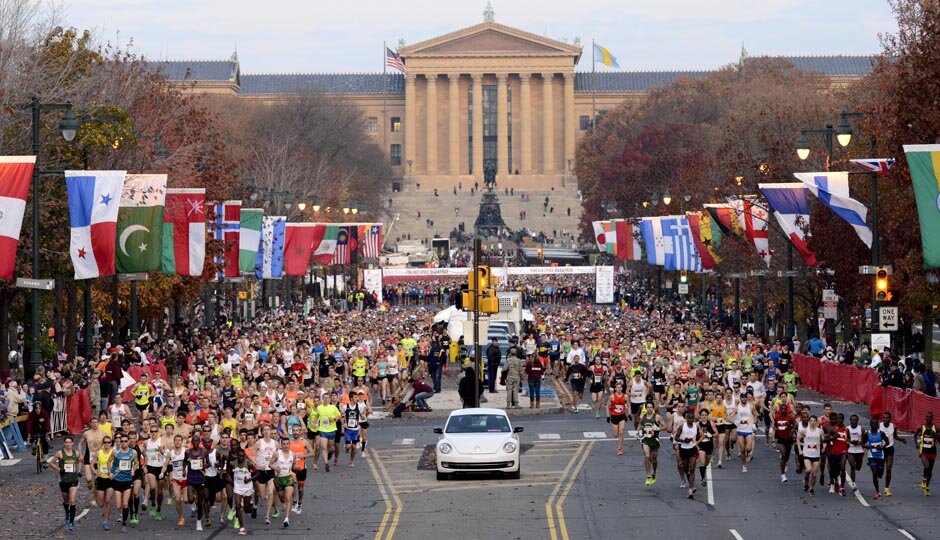
Even though I’d been running for about five years already, I didn’t truly get the running bug until around 2008, when I spectated at the Philadelphia Marathon for the first time. A friend of mine was running at a ridiculously fast and inspiring pace, and I went with family and friends to cheer him on. The energy of the marathon crowd, the look of simultaneous anguish and accomplishment on runners’ faces, and the joy of the finish line all awakened the aspiration in me that I would someday run that race myself. In the back of my mind I figured it would be Philly the following year, and while I didn’t sign up right away, the thoughts in the back of my mind eventually proved true. 

Fast forward a month or so, and I decided on a major running goal for the following year: I would run at least a mile every day and become one of those streakers I’d been reading about. (No, not THOSE streakers… the fully clothed ones who run every day without missing a day!). I have to tell you, even ten years later this was the best resolution I’ve ever made, and one of the few I actually stuck with (sorry, nonexistent yoga practice!). The streak led to my first 5k, which led to a renewed excitement about races, which led to my signing up for the Philadelphia Marathon. I learned that a friend from high school was also running her first marathon and hoping to qualify for Boston with a 3:40, so that became my goal, as well. 

Here’s one of major the lessons I learned that year: rest is key, and when you’re running every day it’s kind of hard to rest. I found that rest is especially challenging with a toddler to care for and another baby on the way (though, these realizations may not be quite as applicable to everyone…) And marathon training with a brand new baby, (not so surprisingly) proved difficult (my training for a marathon while a baby was on the way was obviously more difficult for my wife, but just sayin’).  

Anyway, in my mind it didn’t matter how well my training went, I unwaveringly thought 3:40 would be a piece of cake. Not having run a marathon before, what did I know about the effect weather, the course, how much I drank the day before, etc., would have on the actual running part? It’s not like anyone ever talks about running a marathon or there are magazine articles everywhere dedicated to this sort of stuff, and the internet was still relatively new… and doing research is boring… so cut me some slack!! 

Skip ahead to November 22, 2009… no, skip ahead to mile 16 of the Philadelphia marathon on November 22, 2009: My first sign that something might be wrong was my friend Jill asking, “are you breathing okay?” I thought I was, but she must have known something I didn’t. Not that my breathing became an issue, but I definitely was not “okay”. I was hurting pretty early on but pushing that 3:40 pace anyway. So around mile 16 I learned another important lesson: always include hills in your marathon training. Back in 2009, some of the hilly part of the Philadelphia Marathon was on the back end, after the full marathoners had the pleasure of watching all the half marathoners finish with glory (not as motivating as you might think when you still have 13.1 to run). Anyway, I hit Lemon Hill around mile 14 or 15 or who knows when, and that was my first experience of “the wall”. It killed me. I had to walk sections of the race from that point on. 

I’ve since walked sections of marathons without shame, but this was my first marathon, and I felt awful! I remember the sense of wanting spectators to divert their eyes when I limped past, and to shut up with their “You’ve got this!” attitudes; I just wanted the race to be over with. I don’t even know if it was my lack of sleep, lack of downtime in training, lack of proper nutrition, or what, that led to the proverbial wall, but I did keep going, hoping for at least a sub-4 first marathon (which is honestly a pretty fantastic first marathon, regardless of how I felt about my race in those moments I had to walk!)  

Let’s skip to mile 22(ish) now. Here’s where a learned probably the most pivotal lesson of that race: if you have a goal time, make the potty breaks short. I stopped to pee at mile 22 (Jill had gone ahead on her own long ago, and got her Boston Qualifier, by the way!), stepped back out of the porta-potty somewhat refreshed, ran the rest of the way to the finish line, and celebrated!  

My time? 3:59:77. 

That’s no typo. That’s my way of saying I finished my first marathon, for which I had an A goal and a B goal, in 4 hours and seventeen seconds. SEVENTEEN SECONDS! To this day, I sometimes count when I pee to see what seventeen seconds feels like.  

The best part about my finish time, 4:00:17, though, is that it is MY finish time. From MY FIRST MARATHON! It’s a number that represents success, not failure. Ten years and thirteen marathons later, 4:00:17 is still my favorite finish time, because it represents a meaningful journey of its own, but also the entry to a decade-long path that has taught me so much about myself.

Anyhow, I’m going to wrap up this trip down memory lane now and then regroup with a separate post about my decade in marathoning. To recap, here’s what I learned from my first one: 

1.      Be reasonable. Remember to rest and don’t push yourself too hard if your life circumstances demand time and energy. Be kind to yourself!

2.      Study the marathon course, and include hills (and variety in general) in your training. Be prepared!

3.      Speaking of being prepared, it’s good to have several targets in mind, in case you fall short. I generally have an A, B, C, and D goal nowadays, which includes just flat out living to see another day!

4.      The lines may be long, but it’s always good to use the porta-potty BEFORE the race. Give your nervous bladder a break.

5.      You are doing the best with what you have – know that especially in a marathon, folks understand that you are doing your best, and they are genuine in their words of encouragement.

6.      Learn from your “failures” (I put that in quotes because nobody who has finished a marathon has failed at running a marathon). Enjoy the parts that you can, and let go of the rest – there is always another race! 

Happy Running!!!

One Wit Whiz(dom)

One Wit Whiz(dom)

…many proponents of mindfulness know that its foundation lies in Buddhist thought, but not many talk about it as simply part of the whole foundation. And because my intention with Dharma Running is to provide runners with the tools to become better participants in an interconnected world (and not just better runners), I thought I’d dig a little deeper into the teachings.

Running In The Stream

It’s been awhile since I rapped at ya, and I’ve been meditating for longer periods of time, which usually results in blog post ideas popping into my head (not to mention knee problems).  So here I am with today’s topic: What is this karma thing Buddhists like to talk about, and what does it have to do with my running???

The foundation of my meditation practice, and really the first practice I learned (and where I start teaching), is called shamatha, which is Sanskrit for “calm abiding”.  This is a practice of settling the body and mind in order to get a birds-eye view of our thoughts, feelings, emotions as they arise into our consciousness.  When we are new to meditation, this is when we usually notice just how chaotic and crazy our minds are, and often when we give up, simply because the notion of sitting peacefully with our minds makes about as much sense as trying to play real-life Frogger on a six lane highway.

If our thoughts don’t manage to squash us right out of the gate, we have an opportunity to focus on our breath, on our bodily sensations without judgment, and let them settle into the background, where we can get a better glimpse of just how constant the stream of consciousness really is.  Thoughts never stop generating, and they never stop trying to bubble to the surface, where we typically latch on and go for a ride.  The more we meditate, however, the less power those thoughts have over us.

Usually when I sit in meditation, my thoughts and feelings settle into the background, almost as if they were bubbling up from a well in the back of my head.  But the other day I imagined them in a different way – as objects floating past in a slow-moving stream as I sat watching. And I had a choice as they floated by, to pull them out of the stream, look at them, learn a little bit about them and where they came from, and put them back in the flowing water, or to cling to them and be dragged downstream.

We all know the feeling, right?  Trying to concentrate on something when BOOM! – in a split second we’ve latched onto a feeling that turns into a thought that turns into a storyline, and before we know it we’re floating out to sea.  Have you ever asked yourself what that’s all about?  Why does it happen?  Buddhist teachers would say it has to do with karma, and they’d also tell you it’s the point of this blog post (if they would ever answer my calls!).

Westerners tend to think of karma as a commandment to do good things, because if we do bad things, then bad things will happen to us in return.  This is an oversimplification of the “law of karma” from a Buddhist point of view, and oversimplifying it for a Western audience has led to a broad misunderstanding about the concept.

Karma, which is Sanskrit for “action”, really only refers to the law of cause and effect – the simple fact that every action has an effect.  Every action I take has consequences for myself and others.  Every action you take has consequences for me, for you, for everyone else. Every action we take collectively has consequences for each of us and every other being in the universe. (For a good, yet really bad example of this, feel free to watch the Ashton Kutcher movie Butterfly Effect – cinema at its finest!)

The “good karma/bad karma” thing has some legitimacy, of course. It’s always better to act out of compassion instead of anger, out of wisdom instead of ignorance, out of a sense of togetherness instead of a sense of separateness.  But in Buddhism, a nontheistic religion, there is no godlike authority keeping track of our karmic bank account in order to determine whether we go to the hot place or the cool place – the consequences of our actions are mostly determined by our own minds. We want to act from a Dharma-centric, rather than ego-centric, state of mind, because each action that is not ego-based brings us one step closer to enlightenment. And by doing good in the world, helping others, standing up against injustice and so on, we are bringing the whole world closer to enlightenment.

Even though karma has a lot to do with reincarnation and what Buddhists believe when it comes to the various realms into which we can be reborn, I’m not going to get into that here.  You can Google some pretty good stuff on this (or let me Google it for you), or better yet, find a teacher who gets it better than I do. 

What I really want to talk about here is what karma means to us in terms of our own states of mind, our own happiness, and our own part in bringing happiness and peace to others.  Because every action we take leaves a trace, or karmic seed, with us that will ripen somewhere down the line – maybe in the next moment, maybe in the next year, maybe in the next lifetime.  So the choices we make are a big deal – our initial choice to take action, be it positive or negative, helpful or unhelpful, and the choice we make when the karmic seeds planted now germinate and poke through the dirt of our consciousness – whether to act on the fruition of those seeds in a positive or negative manner, thus planting new seeds that will later come to fruition, and so on and so on and so on.

I was going to include an example of how this works here, but I think you can probably see it in your own life if you spend a few minutes thinking about it.  Think about your habitual responses to certain situations and emotions – do you struggle with anger, insecurity, jealousy?  Close your eyes for a minute and think about a recent situation that brought up some of these feelings and a conditioned response for you.  Back to the notion of the stream of thoughts and feelings: What is it that made you respond the way you did in this particular situation?  I bet if you think back, you can remember reacting the same way many other times, seemingly out of your own control.  Maybe you even noticed then, or remember now, the feeling that arose in your body when your response was provoked.  When that feeling arose, did you cling to it and find yourself tossed into the rapids, or did you manage to look at it mindfully and place it back in the stream?

Letting go of habitual patterns is easier said than done, and that’s the fault of karmic conditioning.  Every time you cling to what bubbled up to the surface, you are that much more likely to respond in the same way next time, even when it may cause you suffering.  Think about addicts, who know full well the pain caused by their addictions, but who can’t keep themselves from taking another hit, from acting out. It’s nearly impossible after awhile to not fall into the trap of planting new karmic seeds that only serve to further entrench that conditioned response.

But there’s hope!  Mindfulness is the key to catching ourselves before we cling or grasp.  It’s mindfulness that allows us a split second of pause before we reach into the stream. As we train ourselves in mindfulness (by meditating and running mindfully), we get better at leaving space around our thoughts so that we can observe them without judgment before responding to them.  With that gap in the process, we can make an informed choice about our reactions, based on the wisdom of knowing what will happen if we act out of a negative view, and the compassion toward ourselves and others that allows us a positive, helpful response. 

And finally we bring it back to running!  Most of us have experienced high and low points throughout our running careers – the days when we jump out of bed before the alarm goes off to enjoy a nice cool morning run on well-rested legs, and the days when we hit the snooze button 27 times, finally get up and decide we don’t have time to run because we have to get the kids ready for school and even 3 cups of coffee is not enough to energize us and wasn’t it stupid to think we could train for a half marathon while our children still lived with us and someone should have stopped me but nobody really cares, do they? 

We’ve all been there.  Times when a flash flood of negative self-talk carries us farther and farther away from the motivation we need to stay on track in our training.  This is just one area in everyone’s running life where mindfulness can make a difference.  When we practice mindfulness, we create the space for the initial trash-talk to sit without a response. The reality is, we know ourselves better than our negative thoughts do. We know that the first step out the door (or off the couch, or out of bed) is the most difficult, and we know that taking that step makes each consecutive step easier. Each action plants seeds that either make it easier to get out of bed or easier to roll over and go back to sleep.  Mindfulness allows us to look our negative thoughts in the face and tell them to talk to the hand, to use my best Valley Girl analogy.  We see them, we put them back in their place, and they float off downstream.  Each time we do that, we make it easier to take that first step, and keep our training on track. 

We can apply the same principle while we run, but we need to be aware that rising thoughts and feelings serve a helpful purpose, sometimes.  We’ve been wired by evolution to always be processing what comes up in our consciousness, lest we follow a mastodon off a cliff or step on a saber-tooth tiger’s tail.  But one thing I’ve noticed that mindfulness brings to my running is a better ability to know the difference between something I can run through and something that should give me pause and make me end my run.  And the more I’ve incorporated mindfulness of bodily sensations into my runs, the more subtle levels of feeling I notice, and the sooner I can make adjustments to my form, pace, etc., that help prevent injury and make me a better runner.

Next time negative karmic tendencies start to surface in your river of thought, see if you can bring mindful space to the experience.  Give them a moment to bubble up, notice them with kindness in your heart and no judgment, and let them continue downstream.  Don’t worry, there will be more.  But each time you let them go, you become stronger in the face of them, and better able to keep yourself running.  Namaste!

Celebrating Global Running Day? Do it mindfully and you can change the world!

All the joy the world contains

Has come through wishing happiness for others.

All the misery the world contains

Has come through wanting pleasure for oneself.

               ~Shantideva, 8th Century Buddhist Monk

The above verse is among my favorite teachings from Buddhist texts, because to me it summarizes the foundation of the religion itself, the lesson behind the Dalai Lama’s most popular quote, “My religion is kindness.”

One of the reasons I love this verse so much is that it highlights how personal intention manifests in the world. I realize that’s quite a generalization, but I also believe that each of us knows in our hearts that chasing after selfish endeavors almost always leads us farther from happiness, and doing good things for other people is one way to experience genuine joy.  Each moment of our existence is another opportunity to direct our intention one way or the other. When we are directed toward pleasure for ourselves, the long-term consequence is that we cut off genuine connection with the rest of the universe. We find happiness more and more difficult to attain, because true happiness comes from connecting, from our desire to enjoy communion with other individuals, with nature, with existence as a whole. When we disconnect ourselves from everything else, we become alienated from that which gives us life and love.

The solution to that suffering, as offered in the above verse by Shantideva, comes in “wishing happiness for others.” When our intention is to bring peace, ease, kindness, and gentleness to everyone else, we sow the seeds of happiness within ourselves. Think of the smiles of children and how contagious they are. Think of how it feels to witness others at their happiest moments. When we open ourselves to those experiences, we cultivate those seeds of happiness. We provide them with the water and sunlight that allows them to bloom.  In other words, we reap what we sow.

Somehow, cultivating the seeds of compassion has not become easier for us simple-minded human beings over the 13 centuries since Shantideva spontaneously (legend has it) recited his verse and then floated up into the ether. Thankfully, the advice he gave his fellow monks on how to let go of anger and focus on love, holds true to this day. The central element of Shantideva’s advice on how to practice the Six Paramitas of Mahayana Buddhism – generosity, discipline, patience, exertion, meditation, and wisdom – is mindfulness:

If, with mindfulness’ rope,

The elephant of mind is tethered all around,

Our fears will come to nothing,

Every virtue drop into our hands.

Think about everything that distracts us from being generous, disciplined, patient, and so on.  We are wired to be easily distracted – early humans never knew when a saber-toothed tiger was going to leap out and eat them, and our bodies and minds have developed a lot more slowly than our technology (there’s an app for that now). Shantideva compared the mind to an elephant – a five-ton beast that will f*** you up if you don’t figure out how to tame it. But tame the beast of mind and, in the words of Pema Chodron, “By gently returning to the present, gradually all our fears will come to nothing, every virtue drop into our hands. When mind calms down, everything seems workable.” Those distractions no longer wreak havoc with our basic goodness, and we are able to focus on what’s important – feelings of loving-kindness toward everyone.

What does any of this have to do with running? I’m glad you asked! Of course you knew I’d get here eventually. As many runners already understand, our sport is one that can support mindfulness organically. We run, we focus on our breath, we notice a thought or feeling, we come back to our focus on the breath, we look out for traffic or poison ivy, we come back to the breath, we feel a twinge of pain, we shift our focus to our form, we subtly change our form to ease the twinge, we come back to the breath…you get the picture.  When we run, we have the ability to nurture the potential for mindful attention that already exists within us. And the more we run with the intention of nurturing that mindfulness, the more natural it becomes. 

Pema Chodron says it (and so many other things) best: “This point is essential: mindfulness tethers the mind to the present. Initially this takes effort, but this effort is applied with a very light touch. It’s like brushing your teeth: you brush, you get distracted, and you just naturally come back. No big deal.” And when distractions are no big deal, are “workable”, we are no longer controlled by the stories we make up about them, no longer attached to thoughts about the past or future, we can be fully present. The saber-tooth tiger sits back on his branch, and we can focus our intentions back on love and compassion toward others. 

Most mindful running programs focus on how to make ourselves better runners. And there’s nothing wrong with that – becoming more efficient at running means we are becoming more fit, healthier, even more sane. With Dharma Running, I am simply asking runners to take their practiced mindfulness to the next level – to go from better runners to better people. And one way to do that, and to change the world for better, is by “wishing happiness for others.” 

What better time to test this out, to put mindfulness to work for the benefit of all beings, than Global Running Day, Wednesday, June 5? One way to do that is to make the object of our mindful meditation, rather than the breath, thoughts of love toward ourselves and others.  One of my favorite meditations, that I teach in Dharma Running workshops, is known as metta practice.  Metta is the Pali word for loving-kindness, or “friendliness”, which may be a better word to describe the open-to-others feeling associated with the practice. 

(Tired of reading? Watch/listen to the following guided meditation here.)

Typically, metta practice is done while sitting in meditation. While there are many versions of the meditation, the way I teach it begins with calming the mind and beginning to focus on the intention of wishing happiness for everyone in the world. Once the mind is calm, the meditator chooses someone who they find it easy to love unconditionally – a parent, child, pet, sometimes even herself. Not a lot of time is spent on choosing – simply the first loved one who pops into your mind will do.  I usually use the inbreath as a time to really bring that person to mind, and on the outbreath I think to myself, “May this person be happy,” while I also imagine love emanating from myself toward them. Many times I imagine loving feelings as bright light expanding from my heart center toward my loved one.

The practice continues this way for a few minutes, with attention growing to the bodily sensation of loving-kindness toward your chosen loved one. Really sense what it feels like to wish happiness for another – how and where does that feeling manifest in your body? Is it a warmth in your heart, a gentle sadness behind your eyes, or maybe a kind and protective feeling in your gut? Just notice what it really feels like to wish happiness for another.

Next our attention moves from that loved one to someone we might call “neutral” – this could be anyone you don’t naturally feel loving instincts toward, but for whom it should be easy to allow those feelings to arise. Maybe a cashier or someone else in the service industry who has helped you today. Maybe a teacher, coworker, someone you simply noticed in passing. Bring your wishes for happiness to this person as you visualize them before you. Again, really try to notice the felt sensation of your loving-kindness as you imagine it spreading to them.

After a few minutes of wishing happiness for your “neutral” person, we move on to someone with whom we may have difficulties – again this could be a coworker, a parent (or in-law!), or even someone who simply makes you cringe when you think of them – politicians are often an easy target. Our attention shifts to this person, and we make an effort to wish them happiness. Remember, you are simply desiring genuine happiness for this person – you don’t have to get too deeply into what that means, or you may find yourself easily distracted. Just continue to think “May they be happy,” while you visualize them before you. If this proves to be too challenging, it’s also ok to skip to the next step, but I challenge everyone to make an effort!

From this “difficult” person, we shift our attention outward, sometimes bringing all of the people we have imagined so far together in our mind’s eye, wishing happiness for all of them together. Slowly we expand the circle to include others – the people sitting next to us, other loved ones and neutral people, strangers outside the meditation hall, drivers passing by, people and animals across the city, country, world. We slowly expand our circle of loving-kindness to include the entire world and all beings on it. We then sit with this feeling for some time, wishing happiness for the world and for ourselves. We visualize peace, love, joy, ease, and simply sit with that sensation for a few more minutes. This is the whole of metta practice.

So how to bring this to our running??? It’s complicated enough to practice this on a meditation cushion or chair, much less while on the run, dodging branches, roots, pedestrians, cars, etc.  How do we maintain the concentration it takes to visualize these different people, wishing them all happiness, and doing it with each outbreath? I’ve thought about this quite a bit while running, and have tried to practice it in a similar way, but it doesn’t translate 100%. My breathing becomes too rapid, my footstrikes take away from the focus on the breath, and it’s difficult to visualize anyone in front of me while I’m on the run! So here’s what I suggest as a starting point for “metta running”:

Before heading out, maybe as part of your pre-run stretching routine, or simply for a moment or two before you start to run, close your eyes for a moment and focus in on your intention for this particular run. If you are in a good place mentally and emotionally to think about the happiness of others, great! If you notice that you are distracted or upset or simply don’t want to try this time, then think about something else – you’ll have other opportunities! If you have done the practice while sitting still once or twice or more, you will start to find it easier to tune into the intention of generating happiness, so don’t beat yourself up. 

Just before you start to run, bring to mind that person for whom you find it so easy to wish for happiness. Take a few deep breaths as you visualize them and repeat to yourself “May they be happy” with each outbreath. Give yourself anywhere from 3-10 breaths or more to really bring that person to mind.

Now, as you begin to run, continue to feel that sense of loving-kindness or friendliness emanate from you. I like to visualize the feeling as something that radiates downward from my feet as I breathe out, sending loving thoughts through the earth to my loved one. As the typical distractions of running occur, I gently bring my attention back to the feeling of love, of friendship, of sharing. And I run with this loved on in mind for several minutes, always bringing my attention back to “May they be happy.” 

See how this feels for a quarter mile.  Can you maintain that feeling for another half mile? A whole mile??? Can you almost feel the warmth spread from your heart, to your feet, into the earth and all around?  For as long as you can, continue to run mindfully this way. 

Maybe that’s all you do today. Maybe you save the “neutral” and “difficult” people for your next run, or for longer runs somewhere down the road. That’s ok – you’re “starting where you are” as Pema Chodron would say. But as your run ends, see how long you can maintain those wishes for happiness for others. See if you can continue to feel the sensation of friendliness as you return to interacting with others. See if you can touch back in to that feeling at times when you might start to feel impatient or frustrated with someone (grocery store lines and traffic are always good places for this practice)! And don’t forget to turn those feelings back on yourself – you deserve happiness too!

For Wednesday, Global Running Day, I hope some of you will take up the challenge of running to make the world a better place by focusing on the happiness of others. Trust me – you will feel a difference all day long. And if you take this practice beyond June 5 – you will find the world becoming a better place, simply because you have shifted your perspective.

Metta meditation instruction for Global Running Day

Slow down the storyline, not necessarily your pace!

Many running coaches, including me, preach the gospel of “Speed builds endurance, endurance builds speed.”  In other words, as you build your endurance with long, conversational pace runs, you will likely be able to go faster in your shorter runs.  And if you include speed work in your training, your LSD (long, slow distance) runs will become easier.  It may seem counterintuitive at first, but slowing down may actually speed you up. On the flip side of that coin, speeding up can slow you down.

 I am a full-on child of the 1980’s, so thoughts about speed and time always bring me back to an episode of the PBS series Cosmos: A Personal Voyage.  The original series, created by all-around brilliant and amazing science guy Carl Sagan (he really deserves his own holiday for blowing the minds of a generation), launched in 1980 and cultivated an intense curiosity about the universe in at least one 12-year-old kid.  One episode in particular (Episode 8: “Journeys in Space and Time”) has stayed with me for all these years, in which Sagan explains how traveling at the speed of light would slow down time for the traveler, meaning that no matter their physical destination, they would show up in the “future”.  In other words, time would slow down for them, but not for the rest of the universe, resulting in a form of “time travel” to the future. 

I’m no scientist, so what I’m about to write has no basis whatsoever in fact, but that’s not going to stop me from pretending it does.  My thought process goes this way:  If traveling at the speed of light slows down time a lot, shouldn’t traveling slower than the speed of light slow down time at least a little bit?  This would help explain how running helps slow down the aging process, right?  I run, therefore I age slower than others, even if it’s extremely subtle and barely noticeable.  Is that how physics works?  I’ve always been more interested in metaphysics.

Many runners know what I’m talking about.  Running fast (relatively) can slow things down.  It can give the runner a different perspective on post-run life.  Part of that simply has to do with making time for ourselves to engage in physical activity.  Part of it has to do with the naturally heightened awareness of body and mind that comes from the act of running itself – the repetitive motion, focus on the breathing and bodily sensations, and need to stay in the present moment that welcome mindfulness even when we may not be aiming for it.  And when we bring meditation to our running, we can develop that awareness even more fully - we can begin to examine our feelings, thoughts, and impulses in more depth.  We can better understand their foundation and change the way we respond to them, or at least offer ourselves the choice to change or not, rather than being driven by impulse and habit.

Deep awareness of the process out of which our feelings turn into consciousness is a major step on the path to enlightenment, at least in terms of the Buddhist teachings.  And because Buddhism is way more analytical and detail-oriented than many self-help “mindfulness” gurus would lead you to believe, Buddhists have a handy-dandy list that explains how this process leads us to the illusion of and attachment to a fixed “self”, and from there to the cycle of dissatisfaction from which we struggle to extricate ourselves.  This list is known as the five skandhas (that means “heaps” in Sanskrit, but you will not be quizzed), and here they are:

1.  Form.  This is our direct experience of the outside world – what I like to call “stuff that happens”.  Of course, our limited senses immediately validate for us the separation of self and other.  Put another way, this is the first filter between direct experience and reality – it’s like yellow-colored lenses that tell us the sky is green and that red is orange.  What we think of as an objective point of view is already skewed by the limits of our sight, hearing, smell, taste, and touch.

2.  Feeling.  Next, we take that experience and rush to judgment about it.  We immediately attach a “feeling” to our experience and decide whether it is one we like (positive), one we don’t like (negative), or one we don’t really care about either way (neutral).  You can start to see a story forming around the “stuff that happens”.

3.  Impulse.  We further solidify the illusion of self and other by placing a false perspective around our experience, embracing that which solidifies the sense of self, avoiding that which threatens it, or ignoring what does neither.  This is where the simple “feeling” from the last step turns into an “attitude” toward the experience, and we start the process of consciously labeling it as good, bad, or indifferent.  Our storyline develops further as we begin to contextualize our experience based on previous experiences.

4.  Mental formations.  Now we’re really getting into the nitty-gritty of putting together our story!  We start to attach labels, opinions, prejudices, thoughts, ideas, interpretations, rationalizations, to our experience.  We are really on a roll here as far as separating ourselves from genuine understanding, which leads us to…

5.  Consciousness.  Here’s where we put the finishing touches on our current chapter, put down our pen, close the book, and put it on the shelf, where it becomes part of our identity.  The story we have just written wraps back around to flavor every future experience, in an endless cycle. 

This process takes place every second, as long as we are alive and sensing the outside world.  For a runner, it may go something like this:

 1.  Out for a run, I step off the sidewalk a little too hard and have a momentary twinge of pain in my left knee.

2.  I don’t like that feeling.

3.  I DON’T LIKE THAT FEELING AT ALL!  It hurts and it kind of reminds me of the sensation I had last year before I was laid up for a month.

4.  DAMN THIS KNEE PAIN! WHY DOES THIS ALWAYS HAPPEN TO ME? WHAT IS WRONG WITH ME? I MUST BE GETTING OLD AND PROBABLY WON’T BE ABLE TO RUN FOR MUCH LONGER.  I SEE A KNEE REPLACEMENT IN MY FUTURE AND MIGHT AS WELL HANG UP MY RUNNING SHOES TODAY.  I SHOULDN’T HAVE EVEN RUN TODAY – WHAT AN IDIOT!  FML!

5.   I USED TO BE A RUNNER, BUT NO LONGER. NOW I AM A GUY WHO USED TO RUN AND I NEED TO RETHINK MY ENTIRE LIFE.  I QUESTION MY VALUES, MY OWN DRIVE IS DEAD.  GUESS I’LL JUST SIT ON THE COUCH AND WATCH JUDGE JUDY – THAT’S WHO I AM NOW.

Maybe it’s easy to see the value in slowing down this process, in creating some slight gaps between skandhas, where we have an opportunity to put things into perspective and make more informed and compassionate decisions about what’s next.  This is where mindfulness comes in.  When we spend time in meditation, whether on a cushion or on the run, noticing our minds, our thoughts, and our feelings as they arise, we can bring our attention to more and more subtle moments within the process of thinking and feeling.  We can train ourselves to slow down the progression of the five skandhas and break free from the storyline before it carries us away.

I experienced this myself while on a month-long Zen retreat that was part of my graduate school education.  My fellow retreatants and I would spend two of our twelve hours a day of meditation outside, sitting in the New Mexico summer sun, where we would sweat and grumble and attract flies that would buzz around and sometimes land on us.  In the first days of the retreat, when a fly landed on my arm or hand or face, I would simply brush it away, reacting instantaneously to the storyline, simple as it may be, that “flies are bad.” 

After a few weeks of daily meditation, though, the process of the skandhas began to slow down and gaps began to present themselves in the storyline about flies.  I became more curious about my relationship to the flies that were landing on me and what would happen if I left them alone.  (I suppose personal hygiene wasn’t on my mind – I only showered three times that month.)  Soon I’d feel a fly land on my arm and before the skandhas could do their thing I would simply notice it walking up my arm and flying off, no harm done.  Once, a fly even landed on my face, crawled up my nostril, back out, and flew off, while I sat there observing and not reacting!

Just as much as sitting meditation can help train the mind to slow down and allow for gaps in the story-making process, so can running mindfully.  Shifting our focus while running from whatever pops into our minds to a specific object of meditation – breathing, cadence, posture – and bringing that focus back again and again while we run, teaches us to slow down the process and not react in habitual ways.  And of course runners know that training at something is what makes us better at it – so train in mindfulness on the run and you will become more mindful minute by minute throughout the day.  You can create gaps in the storyline that leads to suffering and bring more joy to the world!  Namaste.

Coaching for Warriors

“The essence of warriorship, or the essence of human bravery, is refusing to give up on anyone or anything.”
— Chögyam Trungpa, Shambhala: The Sacred Path of the Warrior

In my graduate program at Naropa University, we did things a little bit differently.  I mean, the school was founded by Chogyam Trungpa Rinpoche, a Tibetan lama, with help from the Beat poet Allen Ginsberg and others, so what else would you expect?  We bowed to each other at the start of each class, we often sat on cushions instead of at desks for lectures, and we had an on-campus shrine room so we could meditate in our free time.  Don't get me wrong, Naropa holds its students to high academic standards, but the challenge to think outside the box is just as strong.

One of my favorite Naropa practices is the "Warrior Exam".  In addition to written final exams, some classes held exams "warrior style", with the teacher and student facing each other on cushions in the center of the classroom, all other students looking on.  For my M.Div. degree we participated in a Warrior Exam to which the entire community was invited.  Nerve-wracking stuff, to be sure, but there is an underlying wisdom and compassion to this practice.

The teacher in this setting can be an intimidating presence.  Many of my professors were also teachers in various Buddhist lineages who had been studying and practicing for decades longer than I had.  And of course self-doubt can creep in easily when you're eye to eye with someone who clearly knows more about the subject than you do.  But the goal of the teacher in this type of exam is not to trip you up, not to show what you don't know, but to compassionately help you tap into your inherent wisdom for the answers.

The basis for this practice is an understanding of "Buddha Nature", or the notion that each being holds within the seed of enlightenment, the capacity to wake up.  In the Shambhala lineage founded by Trungpa Rinpoche, this is also known as "basic goodness".  It is simply the nature of things - that any one of us can cultivate within ourselves the wisdom to become a Buddha; that in spite of the suffering we may experience all around, the potential for mindfulness, compassion, and joy is always there.

I don't mean to oversimplify this rather complex and sometimes controversial (especially in Western thought) idea, that some Naropa students spend an entire semester studying in depth.  If you want to know more about it, there are plenty of books by more scholarly folks than myself for you to read (click here to see some of them).  I wanted to write about the Warrior Exam and Buddha Nature because it is the foundation of the Dharma Running collaborative coaching philosophy.

Everything you need to be a great runner lies within you.  In fact, deep down you already know that or you wouldn't be looking for a running coach - you would just give up and maybe learn how to swim or something!  But instead you keep waking up early, lacing up those running shoes, heading out the door, and putting one foot in front of the other because of your own inherent wisdom, a faith in your own abilities.  Sure, you may find yourself hitting the snooze button from time to time, or holding back when you're sick or just plain exhausted, but that's wisdom too - if you are listening to your body, you know what's right for you.  You'll get back out there the next day!

My goal as a running coach is threefold:  First, I want to help my clients see what they already know, to bring out those natural abilities and create a plan to keep them in the foreground.  Second, I want to provide guidance on any adjustments that can be made to enhance those natural running skills.  We will look at training, nutrition, sleep, and other habits that can serve to either augment or diminish your inherent ability to run well.  Finally, we add mindfulness practices to the formula, making it easier (and more enjoyable) to stick with the plan (or to be ok with changing it up when the need arises), and providing you with the tools to hold yourself accountable.  Of course, I stick around to help you stay accountable, but again, what you need is already there. 

Each of us can be a running warrior.  We have what we need.  Training and practice are the tools to cultivate the seeds of our body's inherent wisdom, and to awaken the runner within.  Don't give up!

Where Does Mindfulness Begin?

Do a Google image search for “mindful running” (actually, I did it for you here) and you will be greeted by picture after picture of peaceful, happy folks trotting through beautiful scenery.  They jog up pristine mountain trails, plod through gorgeous redrock canyons, and scurry along sunlit beaches.  Sometimes they are alone, sometimes surrounded by other running models, and sometimes they even have their grinning dogs with them. 

None of this has anything to do with mindfulness.

Sure, these images paint a pretty nice picture of the peace and joy that mindfulness can bring over time to those with the luxury of deepening their practice to such a great extent.  And it can certainly garner click-throughs to websites that may offer something more substantial (maybe it even brought you to Dharma Running!), but there is an unconscious message in these images that I believe can be very damaging to the mindful running movement and to anyone who is interested in running and living more mindfully:  That you need peace and joy to find peace and joy. 

That all makes for nice marketing, but it is far from the truth.  In my experience, and in what I have heard and read from some of the most awakened teachers I know, a mindful life doesn’t require a run through the woods any more than it requires a shaved head, robes, and incense.  Sure, those things can certainly be excellent tools on your path to deeper awareness of yourself and the world, but to believe they are necessities actually misses the point of mindfulness altogether.

The real place where mindfulness is best practiced, the beginning of genuine awareness, is almost always on the edge of discomfort.  As someone who studied and practiced Buddhist meditation in the shadow of the pine-forested Rocky Mountains, I can attest to this first-hand.  It wasn’t until I moved back to Philadelphia after more than a decade away that the rubber hit the road, that I realized mindfulness means nothing if you can’t use it in the real world.  Who really needs mindfulness when you can watch beams of light shine through the aspens, or hear the birds singing joyfully, or feel and smell the fresh breeze that cools your sweaty brow as you zoom down the single-track?  I’ll tell you who – almost nobody!  Mindfulness is practically built in to situations like that!

No, when you really need mindfulness is when you are trying your damnedest to send your kids off to school so you can get in a lousy run before you need to leave for work.  You need mindfulness when it seems like you need to stop at every traffic light, or when you have almost been hit by three sidewalk cyclists in your first quarter mile.  You need mindfulness when it’s 85 and thick with humidity, and your legs do not seem to want to obey your brain.  You need mindfulness when 75 runners just passed you at the start of your race and you are trying not to feel like you’re faltering with each step forward. 

I mean, you don’t really need mindfulness in those moments, but it sure can help you be a better runner.  Just like you don’t need mindfulness when you’re feeling frustrated in the self-checkout line at the grocery store, or when you picked the wrong toll lane, or when you’re trying to get your kids off to school…but mindfulness can certainly give you the tools to handle those situations with more grace and happiness, less rage and frustration.

Mindfulness starts within, no matter what the brochure tells you.  And yes, it is sometimes easier to cultivate mindfulness on the trails or the beach, or from your mountain retreat center.  But most of us do not have that luxury – we want to begin our practice here and now.  We don’t need to put it off until we have the time or the space or the right frame of mind.  Cultivating mindfulness is about developing the right frame of mind, and there is no place or time to begin like here and now.  Take a breath, notice what comes up, and come back to your breath again.  Put one foot in front of the other, watch how the sunlight makes the dirty asphalt glimmer, listen to the beautiful sound of someone’s car alarm, feel the sweat start to pool in uncomfortable places, smell the…well, you get the picture.